Steven R. Southard
 |
Growing up in the Midwest, Steven R. Southard
always found the distant oceans exotic and tantalizing. He
served aboard submarines and now works as a civilian naval
engineer. In his stories, he takes readers on journeys of
discovery in many seas and various vessels. Steve has written
in the historical, science fiction, fantasy, horror, and
steampunk genres.
Visit Steven's new website at:
http://www.stevenrsouthard.com |
Congratulations to Steven for being in the 2012 Preditors and Editors top ten
Short Story Romance and Short Story Steampunk Categories for
Against All
Gods (romance) and The Six Hundred Dollar Man (steampunk)
and 2013 and 2016 top ten in Sci-Fi/Fantasy Category (#2!) for A Tale More
True and After the Martians respectively; 2014 top ten in Steampunk for Time's Deformed Hand
and top ten in Short Story Other for The Cometeers.






New Titles from Steven R. Southard




Click on the thumbnail(s) above to learn more about the book(s) listed.
|
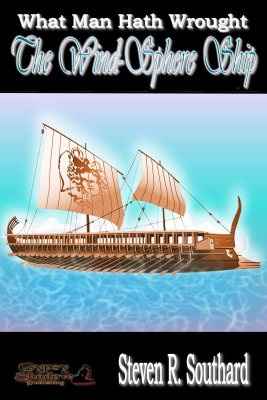
Heron of Alexandria, in the 1st Century A.D.,
invented a primitive steam engine he called an aeolipile, or
“wind-sphere.” Persuaded by his friend Praxiteles, he used this
engine to propel a ship. If his steam-ship could beat a
man-rowed galley in a race, could Heron bring about the
Industrial Revolution 1700 years early? The action never ebbs in
this tale of friendship, technological vision, and one of
history’s missed opportunities. Let the race begin!
Excerpt
Word Count: 6000
Buy at:
Smashwords (all formats) ~
Barnes and Noble ~
Amazon
Price: $2.99
|
|
|
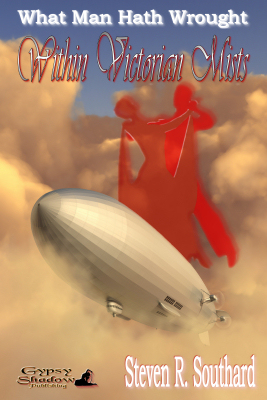 |
If the fog of time had lifted a bit differently
on the 19th century, and you could mix a hauty Englishman
tinkerer, a plucky American steam engine repair-woman, laser
holograms, giant dirigibles, and ornithopters, you might just
get one madcap steampunk romance. Strap on your brass-rimmed
goggles to see what happens... Within Victorian Mists.
Excerpt
Word Count: 6800
Buy at:
Smashwords (all formats) ~
Barnes and Noble ~
Amazon
Price: $2.99
|
|
|
|
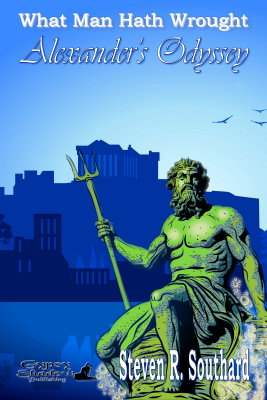
Alexander the Great might well be on his way to
conquering the world, but when he decides to explore underwater
in a glass-windowed wooden barrel, he enrages Poseidon. The
other gods may debate Alexander’s fate and make their deals on
Olympus but the ocean deity is determined to frighten the young
King out of the watery realm. Will Poseidon defeat Alexander and
prevent future deep-sea exploration by mortals, or can a single
clever Macedonian outwit a god?
Excerpt
Word Count: 7880
Buy at:
Smashwords (all formats) ~
Barnes and Noble ~
Amazon
Price: $3.99
|
|
|
 |
In 1515, Leonardo da Vinci built a mechanical
lion to entertain King Francis I of France and his guests. Until
now, no one knows what happened to this amazing clockwork
creation. Over half a century later, when a ten year old boy
discovers the lion in a royal storeroom, young Chev doesn’t know
he will soon embark on a strange and dangerous mission. His
quest will lead him many leagues through a French countryside
devastated by religious war in search of Leonardo’s greatest
secrets of all, hidden mysteries that could affect the future of
all humanity.
Excerpt
Word Count: 8700 nbsp;nbsp;
Buy at:
Smashwords (all formats) ~
Barnes and Noble ~
Amazon
Price: $3.99
|
|
|
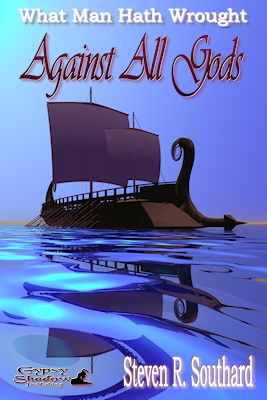 |
In ancient Athens, trireme commander Theron and
the woman he loves, Galene, have each earned the wrath of
jealous gods. To marry Galene, Theron must voyage to all seven
Wonders of the World. At every stage the immortal gods test
their love with all the power and magic at their command. While
Galene suffers anguishing torment in Athens, Theron faces
overwhelming challenges at every Wonder from Ephesus to Rhodes
to Babylon. Theron and Galene may be devoted to each other, but
it’s doubtful whether mere mortal love can survive...against all
gods.
Excerpt
Word Count: 13000
Buy at:
Smashwords (all formats) ~
Barnes and Noble ~
Amazon
Price: $3.99
|
|
|
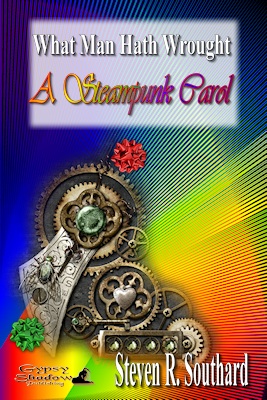 |
That stuffy Victorian inventor, Stanton Wardgrave, is back
again, eight years after inventing holograms and meeting the
American Josephine Boulton. Married now, with a son and
daughter, he’s dealing with rather too much balderdash and
poppycock this Christmas Eve. Conversing with his dead father?
Expecting three visitors? It all seems so very Dickensian. But
he knows he’s not at all like that Ebenezer Scrooge fellow...is
he? What, this story asks, would Christmas be without a bit of
steampunk in it?
Excerpt
Word Count: 5700
Buy at:
Smashwords (all formats) ~
Barnes and Noble ~
Amazon
Price: $2.99
|
Reviews
From
Coffeetime Romance and More
|
|
|
|
 |
Sonny Houston, cowpoke. A man barely alive. “I
can rebuild him, make him the first steam-powered man. A darn
sight better than before. Better, faster, and a heap stronger,
too. I’ve got the know-how.” A century before any bionic man, a
doctor in the Wyoming Territory attached steam powered legs and
an arm to a man trampled in a stampede. Get ready, Pardner, for
a rip-roarin’ steampunk adventure!
Excerpt
Word Count: 7000
Buy at:
Smashwords (all formats) ~
Barnes and Noble ~
Amazon
Price: 2.99
|
|
|
 |
Baron Münchhausen has been known to stretch the
truth a bit, then tie it in knots, toss it on the floor, and
stomp on it. But to prove him wrong, is it really necessary for
Count Federmann to construct a gigantic clockwork spring and
launch himself to the Moon? If the Count should do so, and if he
should drag his trustworthy servant along, perhaps he’ll learn
enough to tell... a tale more true.
Excerpt
Word Count: 10500
Buy at:
Smashwords (all formats) ~
Barnes and Noble ~
Amazon
Price: $3.99
|
|
|
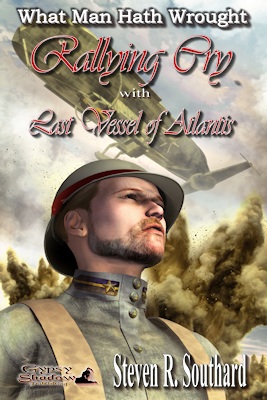 |
Two adventure stories packaged together! In “Rallying Cry,” an
aimless youth meets two old geezers who spin bizarre war
stories. They tell of a secret World War I regiment in France
with ship-sized helicopters and mechanized walking tanks. Just
as an inspiring shout can move soldiers to action, perhaps all
Kane really needs to turn his life around is a rallying cry. In
“Last Vessel of Atlantis,” a ship captain and his crew of
explorers return to find Atlantis gone. While facing violent
savages, braving fierce storms, and solving internal disputes,
they must somehow ensure their advanced Atlantean civilization
is not lost forever.
Excerpt
Word Count: 11400
Buy at:
Smashwords (all formats) ~
Barnes and Noble ~
Amazon
Price: $3.99
|
|
|

|
Two intriguing historical tales packaged
together! “To Be First” follows two space voyagers from an
alternate universe as they return from the moon, in 1933. In
their timeline, manned rocketry began in the Ottoman Empire,
which advanced and spread. When these Ottoman lunanauts end up
orbiting our comparatively backward world, they have a choice to
make, one that will forever change their future and ours. In
“Wheels of Heaven,” an arrogant Roman astrologer finds a geared
Grecian machine for predicting the positions of celestial
bodies. On the voyage back to Rome, he meets a sailor who
dismisses astrology, an astonishing notion in 86 B.C. But when
the sailor's prediction is right, and every one of the
astrologers is wrong, he must question his most basic beliefs.
Excerpt
Word Count: 10350
Buy at:
Smashwords (all formats) ~
Barnes and Noble ~
Amazon
Price: $3.99
|
|
|
 |
A huge comet speeds toward a devastating
collision with the Earth, but no one will launch space shuttles
filled with nuclear weapons. It’s 1897. Instead, they’ll fire
projectiles from the Jules Verne cannon and try to deflect the
comet with a gunpowder explosion. Commander Hanno Knighthead
isn’t sure he can motivate his argumentative, multinational crew
of geniuses to work together. It turns out one of them is a
saboteur. Then things get worse. Only a truly extraordinary
leader could get this group to cooperate, thwart the saboteur,
and jury-rig a way to divert the comet. Lucky thing Hanno
brought his chewing gum.
Excerpt
Word Count: 10500
Buy at:
Smashwords (all formats) ~
Barnes and Noble ~
Amazon
Price: $ 3.99
|
|
|
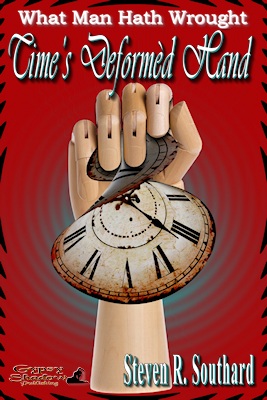 |
It’s 1600 in an alternate Switzerland, a world
where Da Vinci’s mechanical automatons and human-powered flight
almost work, thanks to magic trees. Long-separated twins, Georg
the reluctant groom and Georg the clock thief, roam the
clocklike village of Spätbourg, beset by more time and date
errors than you can shake an hour hand at. Will Georg get
married after all, and repair the town’s central tower clock?
Will Georg—the other one—purloin more timepieces, or give up his
pilfering ways? Will William Shakespeare lend a hand, and some
iambic pentameter poetry, to reset the cogs and gears of this
zany comedy? Only time will tell... or maybe not, in this
ultimate clockpunk tale of mistaken identity and temporal
mix-ups.
Excerpt
Word Count: 10100
Buy at:
Smashwords (all formats) ~
Barnes and Noble ~
Amazon
Price: $3.99
|
|
|
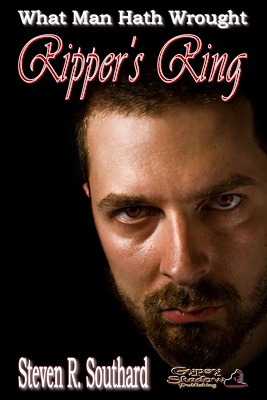 |
In the East End slums of London in 1888, a
carriage-man named Horace Grott takes a ring from a corpse. Not
just any ring, it’s the one Plato wrote about, the legendary
Ring of Gyges, which makes its wearer vanish. With this power of
invisibility, Horace steals food, lives in mansions... and
commits murder. Within Scotland Yard, Detective Wellington
Bentbow works to solve a mystery only he can decipher, reaching
conclusions nobody else would believe. Learn why the crimes of
Jack the Ripper have never been solved, and ask yourself whether
you could resist the awesome and ghastly temptations of Plato’s
Ring of Gyges... Ripper’s Ring.
Excerpt
Word Count: 15700
Buy at:
Smashwords (all formats) ~
Barnes and Noble ~
Amazon
Price: $3.99
|
|
|
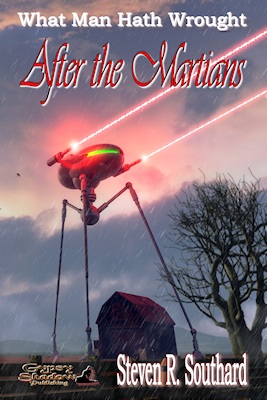 |
In 1901, the Martians attacked Earth, but tiny bacteria
vanquished them. Their advanced weaponry lay
everywhere—three-legged fighting machines, heat rays, and poison
gas. Now, in 1917, The Great War rages across Europe but each
side uses Martian technology. Join Corporal Johnny Branch, a
young man from Wyoming, as he pursues his dream to fight for
America. Follow magazine photographer Frank Robinson while he
roams the front lines, hoping to snap a photo conveying true
American valor. Perhaps they’ll discover, as the Martians did
before them, that little things can change the world.
Excerpt
Word Count: 14248
Buy at:
Smashwords (all formats) ~
Barnes and Noble ~
Amazon
Price: $3.99
|
| |
|
| |
|
| Excerpts |
The Wind-Sphere Ship |
I see you’re playing with your toys again.”
Heron started at the voice breaking the silence of the room.
Candle flames flickered with the approach of the newcomer. Heron
relaxed as he recognized the voice of his old friend.
“Greetings, Praxiteles.” He returned to tinkering with a
mechanism positioned atop a pedestal. “Have you come to torment
me in particular, or do you generally go about frightening old
men at night?”
“I torment all old men who haunt the gods’ temples after dark,”
rejoined Praxiteles, smiling, “so yes, just you.” They stood
alone within a cluttered workroom at the rear of the Temple of
Saturn.
Heron looked up into his friend’s eyes. Praxiteles possessed
huge, wide-open eyes, eyes that missed nothing, eyes that seemed
able to pierce fog and human deception. They had to be huge, to
see around that nose, he thought, surely the largest eyes and
nose in all of Alexandria. “Be so good as to hand me a candle,
won’t you?”
“What are you working on now?”
“I’ll show you.” Heron said, replacing a cover on a cylindrical
machine adorned with ornate decorations and taking the candle
from his friend’s hand. “Drop a five drachma piece in the slot
and cup your hands beneath the spigot.”
“Oh, so my curiosity shall cost me, is that it?”
Heron held up a finger and kept his face expressionless. “Just
one pentadrachma. Pretend you’ve come here as a faithful
worshipper of Saturn.”
“That will take some pretending,” Praxiteles said.
Heron smiled, knowing that his friend―a history teacher at the
Alexandria museum―regarded religion as one of the forces shaping
the larger human story, nothing more. Faiths come and go, as
Prax would say, and in Alexandria these days one could find
adherents to the Roman gods, Jews, and even believers in a new
offshoot of Judaism who claimed their messiah had come. Heron
himself, though a teacher of mathematics and physics by day,
enjoyed his hobby of constructing automated mechanisms for the
temples. Since people thought his devices were supernatural,
Heron rather took pleasure in his role as the “god” behind the
machine.
Groping in a pouch dangling from his belt, Praxiteles found a
coin and dropped it into the slot. From within the cylinder came
a clinking noise followed by two soft bumps. Five tiny drops of
water plopped into his hands. Prax wore a bemused expression as
he looked up at Heron. “Saturn is not very generous this
evening.”
Heron glowered at him. “I was still adjusting the mechanism when
you barged in. Before I’m through, it will fill your palms with
enough holy water to cleanse your face.” He lifted the cover and
reached all the way in to retrieve the coin. “Here, Saturn
grants you your money back.”
Praxiteles looked at the pentadrachma in his hand, then back at
the machine. “It is a miraculous device, Michanikos.” He used
his nickname for Heron―machine-man. “Worshippers will be
awe-struck.” His face clouded then. “But I’ve been doing some
thinking about these deceptions and amusements you create.”
“Oh?” Heron, with his hand back inside the holy water dispenser,
had resumed tinkering with the lever and valve linkage.
“When do you plan to let your automata do something more?”
“I told you, Prax, with some adjustment, this will provide
enough water―”
“No, no, I mean something different, something more
useful.”Heron looked at his friend, perplexed. “I don’t
understand.”
|
|
Back to The Wind-Sphere Ship |
Within Victorian Mists |
Hoping for success this time, Stanton Wardgrave threw the knife
switch. Through smoked-glass goggles, he watched his apparatus,
fearing another failure. On the laboratory table, an image began
forming at the end opposite the gleaming mirrors and prisms. A
reddish apparition shimmered there, a tall, glowing blob lacking
any distinct features or shape of its own. A voice issued from
the crimson ghost, Stanton’s own voice.
“John, by the grace of God King of England,” the voice said,
“Lord of Ireland, Duke of Normandy and Aquitaine, and Count of
Anjou, to his archbishops, bishops, abbots, earls—”
“The bloody devil take it!” Stanton said as he jerked back on
the switch lever to open the circuit. The apparition vanished.
Its voice ceased. Stanton stared at the arrangement of prisms,
mirrors, and lenses, wondering what other adjustments he could
make now. Nothing seemed to make a difference.
“Sir, may I present—”
“MacSwyny!” Stanton tore off his goggles to glare at his rotund,
red-haired servant standing at the laboratory’s entrance. “I
told you not to interrupt...” he trailed off as he saw other
people silhouetted by the sunlight in the doorway behind
MacSwyny.
“Apologies, sir,” MacSwyny rolled the final consonant, “but ‘tis
Tuesday. Two o’clock on Tuesday.”
Stanton straightened up. “Confound it, man. My no-interruption
rule remains in force on Tuesdays at two o’clock, and at all
other times. Now, go.” Stanton dismissed him with a wave of his
hand.
“Sorry, sir,” MacSwyny remained stationary, but looked
uncertain, “but ye had agreed to meet with your sister at this
hour.”
“Eh?” Stanton frowned, searching the backroom shelf of his mind
reserved for social trivialities. “Amelia... Tuesday...
ah, yes, I recall now.”
“Oh, now you recall,” Stanton’s sister Amelia entered the
laboratory, blonde curls bouncing beneath her pink bonnet.
“After we’ve trudged all the way from the house to your dreary,
dusty hideaway.”
“Amelia, I’ll not put up with—”
“And did you also recall that I was to introduce my friend to
you today?” Amelia curled a gloved finger and a second woman
entered the room. “She’s the one I told you about, whom I
befriended during my trip to America. Now she’s visiting here.”
This newcomer stood taller than Amelia, almost to Stanton’s
height. Overcome by his foul mood, Stanton noted very little
about her other than her shoulder-length brown hair and rather
plain blue traveling garments.
“May I present Josephine Boulton, from New York, in America,”
Amelia said.
The American stuck out her right hand. “Pleased to meet you, Mr.
Wardgrave,” she said, in a pleasant alto voice marred by a
jarring Yankee accent.
Stanton was taken aback, being used to bows and curtsies at
formal introductions.
“Charmed, Miss Boulton,” he shook her hand, surprised at the
firm grip. “I really must apologize for the condition of my
laboratory.” With a glare at MacSwyny, he added, “I wasn’t
expecting visitors.”
“It’s your own fault, really,” said his sister. “If you
concentrated on your social appointments as much as you think
about this—whatever it is...” She waved a hand over the
experiment table as if to sweep it away. “For some reason, when
I mentioned your silly laboratory to Josephine, she actually
wanted to see it, didn’t you, Jo? Well, I must go now. Entertain
Josephine, won’t you, Stanton? And try not to bore her to
exhaustion.” Amelia strode out the door with shocking swiftness.
“What?” Stanton stared after her in open-mouthed disbelief.
“Amelia! Come here!” He ran to the door, but saw no sign of her.
No doubt she’d hidden among the hedges of his nearby garden. If
he ran out to find her, she’d skip to a different hedgerow until
they would both be scampering about, making them both look
foolish. Stanton knew his sister’s games too well.
So now Amelia was playing the matchmaker again. Stanton
snickered at the thought of just how wide of the mark her
Cupid’s arrow had flown. Not only was he uninterested in the
burden of female companionship at the moment, but even if that
had been otherwise—what on Earth would attract him to this
Yankee creature?
Still, the present situation wouldn’t be helped by undue
rudeness to a guest. “I’m terribly sorry, Miss Boulton,” he
cleared his throat as he re-entered the laboratory, “this is all
most unseemly, you being here without a proper chaperone. We
must locate my sister at once.”
“Chaperone?” the woman looked up from the apparatus on the
table, at which she’d been gazing. “Am I in danger, here with
you and you servant?”
“Absolutely not,” Stanton said. “It’s just... well, it isn’t
done...” Did Americans not know the rules?
“That’s settled, then,” she said, “and I’d very much like you to
explain this equipment here.” She pointed, her finger almost
brushing a mirror.
“Don’t touch that!” Stanton snapped. Then, softer, “I’m sorry.
Please, just leave the equipment alone. It’s delicate and much
too complicated to explain to, uh, to...”
“—to a woman?” Boulton frowned at him and crossed her arms.
“Well, of course, to a woman,” Stanton said. “This is intricate
machinery, well beyond the understanding of any—”
“It’s an experiment in optical physics,” she interrupted,
returning her attention to the table. “Here you use electricity
from a voltaic pile to produce light. Over here you split the
resulting beam, and there you guide the beams with mirrors and
lenses to that end of the table. The light rays meet there at an
acute angle...”
Stanton blinked. This strange woman had somehow correctly
guessed at the rudiments of his device. He found himself rather
impressed with her powers of discernment. What sort of female
was this?
“. . . and from the noise you were making as we approached your
laboratory,” she continued, “I deduce that this machine doesn’t
work.”
“It works, indeed,” Stanton struck a defensive tone, “just not
as well as I would like. You see, this device with the ruby rod
and the mirrored ends produces a powerful coherent beam of
light. I call it a ‘dynaphoter,’ from the Greek for ‘mighty
light.’ Where the separated dynaphoter rays meet again they form
a picture in three dimensions. I call the entire apparatus an
‘Omni-Sim,’ from the Latin for ‘whole image.’”
“You could as well have stuck with Greek and called it a
‘holo-gram,’” the young woman pointed out.
Stanton would not admit that he liked that name better. “I’ve
kept the Omni-Sim small,” he went on, “so that it can be packed
up and carried in a briefcase.”
“Can you turn it on and show me?” Josephine asked with a hopeful
smile.
“I really don’t think—”
“I’d love to see it. The whole thing sounds wonderful.”
Stanton sighed. “Ah, well. Please bear in mind that it is an
uncompleted project. First, however, you must don goggles to
guard against the hazards of the dynaphoter rays.”
He handed her the goggles usually worn by MacSwyny when he
assisted Stanton, and told MacSwyny to avert his eyes. The
goggles featured brass frames, darkened round lenses, and
leather straps to go around the head. Josephine removed her
sky-blue bonnet and put on the goggles without hesitation, as if
part of her daily wardrobe.
When Stanton turned on the machine, the same vague reddish blob
appeared, and the voice began speaking again.
“It’s amazing!” Josephine studied the ghostly apparition from
all angles. “And it speaks quite clearly. What is it reciting?”
“The Magna Carta,” Stanton said, still disappointed in the
Omni-Sim’s image quality and in his complete lack of ideas for
improving it.
|
|
Back to Within Victorian Mists |
Alexander's Odyssey |
Poseidon wondered if the mortals were, once again, up to no
good.
The sea-god knew several ways to monitor their activities, but
preferred appearing among them in human form. Mortals reacted in
a more natural way, and revealed more, when among their own
kind. Therefore, when he’d been informed by an alert dolphin
about an odd construction project on a beach in the eastern
Mediterranean, he had decided to investigate it himself.
While walking toward the large, barrel-like object he thought it
did appear most unusual. He frowned as he smelled a burnt, oily
odor spoiling the salt breeze. Four humans worked on the upright
cask, a couple of them standing on stools to reach its upper
parts, their white clothes splotched with black smears. The
barrel stood taller than a man and spanned three cubits at its
midpoint, tapering to two at the circular top and bottom. Six
square glass panels ringed its circumference one quarter of the
distance down from the top.
One of the workmen looked up at his approach. “Pelagios! We
heard you were sick. You look well enough to work. Join us.
There are extra rags.” He dipped his own cloth in a heated
cauldron of tar and spread the black, viscid substance where
some of the wooden barrel staves joined together, rubbing to
work the sealant into the seams.
“I’m feeling better now,” Poseidon said. During the night he’d
come to the workmen’s tent and waved a hand over one of them,
imparting a fever to the slumbering man. He’d then assumed the
size and shape of that laborer, evidently named Pelagios. “I’m
ready to work again. But first, friends, tell me the purpose of
this barrel.”
All four of them stopped daubing tar and looked at him. “What?”
one of them asked. “Why, only yesterday you were... Ah, I
take your meaning now,” he smiled. “He has a riddle for us, men.
Very well, Pelagios. What is the purpose of this barrel?”
Inside, Poseidon seethed. These humans were maddening! He felt
like killing them all with a thought, but restrained the
impulse. He needed the information he’d come for. “No, I have no
riddle. Perhaps I’m not fully myself yet today. I must have
forgotten about the barrel. If you wish me to help, I must first
know what manner of thing I’ll be toiling with. It’s an odd
thing, this cask with windows.”
Three of the workers showed a mix of puzzlement, suspicion, and
indifference. The other seemed more sympathetic, and spoke.
“Mark well, Pelagios. Pretending forgetfulness won’t relieve you
of your duties. You know full well the King ordered this special
barrel—his Colimpha—built. He intends to weight it down with
stones, get inside it, seal the opening on top, and then be
lowered from a ship into the depths.” He paused to work some of
the tar in at the edge of a square window, taking care not to
smear the glass. “Now that I think of it, I don’t know if that
makes us coopers, or shipwrights, or both, eh men?” He laughed
and the others joined in.
Poseidon did not laugh. Anger rose within him like the tide;
this sounded like a new and different way for mortals to enter
his realm. He struggled to keep the edge out of Pelagios’ voice.
“Why is the King doing this?”
The workman nodded his head to the southwest toward an island in
the distance with high stone walls rising from its shores. “It’s
said he wants to check on how our divers are doing.”
“Divers?” Poseidon fought to keep patient.
The laborer sighed again. “You’ve forgotten even that? We must
remember to keep you and wine safely separated, or you’ll forget
your own name!” The others chuckled at this and he continued,
“The cursed Tyrians put obstacles underwater to impede our war
galleys—jagged boulders and pointed spars. Divers are removing
them.” He looked around, then leaned closer and lowered his
voice, “I think the real reason for this Colimpha is the King
wants to go beneath the deeper parts of the sea. You know how he
loves to explore and conquer. I think he wants to be King of the
fishes, too!” He laughed once again and the others also enjoyed
the joke.
The bitter feeling inside Poseidon kept surging like a
storm-whipped wave. His jaw set, but he kept his tone
inquisitive, curious. “Why would the King risk angering
Poseidon?”
The man smiled. “You and I would worry about that, but not
Alexander. He’s not afraid of anything—man, beast, or god. I’ll
wager he’s actually looking forward to tweaking the old
seaweed-eater’s nose!”
Poseidon felt his rage burst like a bubble. He glowered at the
cask, then faced the sea. His eyes blazed, boring into those
opaque, blue waves, into the dark fathoms beneath.
In a few moments he heard a worker shout, “By all the gods,
look!” Advancing toward their spot on the beach came a huge
wave, its white crest towering fifty cubits above the otherwise
calm waters. At its southern end, the monstrous wall of water
tapered to nothingness, sparing Tyre and its teeming populace.
As it neared the beach, its main peak dwarfed the Colimpha and
the men.
“Run!” the laborers shouted, and one paused to tug Pelagios’
arm. The man gave up and sprinted inshore across the sand.
But Poseidon did not budge. As if fixed in place, he watched the
mighty wave bearing down on him like a moving, blue mountain. He
heard it now, a monstrous, deafening roar of gurgling,
splashing, crashing spray and water. The sea-god smiled,
admiring his destructive creation, summoned by his own command.
As if drawn by a heavenly chariot, a large, billowing cloud
passed in front of the sun. The sky darkened. In quick
succession, four jagged lines of lightning lanced downward. Each
bolt smote the immense wave, sending forth gigantic plumes of
steam. A fierce, sustained blast of wind came from nowhere and
whipped seaward, meeting the onrushing wall in a titanic contest
between the elemental forces of air and water.
Battered and beaten, the wave rushed on, much lessened in
height. Reduced to a gentle roller, it swept up the beach and
doused the fire beneath the cauldron of tar, then wetted
Poseidon’s ankles and the bottom of the King’s Colimpha before
receding back to the sea.
Only one being could be responsible for preventing his
destruction of the vessel, and the sea-god knew whom, if not yet
why. Poseidon glared at the cloud as it moved past, allowing the
golden sun to reappear. In a voice of fury, as loud as crashing
surf, he yelled, “Zeus!”
|
|
Back to Alexander's Odyssey |
Leonardo's Lion |
With his good hand, Chev opened the door, eased through it, and
stood with his back against the oak portal, panting.
“Mon Dieu!” An old man looked up from his desk. “A visitor,
here? By all the Saints! I never get visitors. No one ever comes
to see old Gaspard...” His creaky voice trailed off to a mumble.
“I’m sorry, Monsieur,” Chev interrupted in a whisper, unsure if
he could trust the old man. “Please don’t tell anyone I’m here.”
Since escaping the orphanage earlier that day, he’d been trying
to avoid people, clinging to shadowed alleys, hiding in alcoves,
and squeezing through wall cracks. Any adult who saw him, he
feared, would turn him over to the authorities and he’d be back
where he’d started.
“I won’t give your secret away, for goodness’ sake.” Gaspard
stood and beckoned to Chev. “Come in, lad. Make yourself
comfortable. I enjoy company, and that door so seldom opens.
What’s your name, son? And how old are you? You look no more
than ten. Very young to be running in fear...” He continued
speaking in a low murmur.
“My name is Chev, Monsieur,” he began to catch his breath. “I
don’t know how old I am.” Chev dared not tell him he’d come from
the orphanage.
“What happened to your hand, young Chev?”
“I caught the holy fire disease,” Chev looked down at his right
forearm to where it ended in a rounded stump. He would never
forget the pain that day the monks cut off his blackened,
withered hand while telling him it was necessary to save his
life.
The man nodded. “I’m sorry for you. A terrible thing.”
Chev looked around at the room’s vast interior. “What is this
place?”
Gaspard swept his hand in a jerky manner. “Welcome to King
Charles’ Storeroom. Here go all the old, forgotten gifts and
decorations, all the royal possessions from the Amboise palace
no one bothered to send to Paris. These wine goblets, for
example, were given to Louis XI in 1475. And this scepter...”
Chev stared in disbelief at the amazing riches stacked in
haphazard confusion in floor-to-ceiling piles. The heaps
included armor, tapestries, books, portraits, musical
instruments, polished wood furniture, ornate boxes, tableware,
and jewelry.
“...and with this sword, King Charles VI knighted Sir Ambroise
de Loré in 1415,” Gaspard continued. “Notice this exquisite
chessboard given to King Philip VI in 1345...”
While Gaspard droned, Chev wandered to where the fancy clothing
hung, each garment featuring delicate trim and bold colors. He
brushed some of the clothes with his hand, feeling the smooth
fabrics, devoid of holes or rips.
A fearsome face stared out from behind some garments as he swept
them. Chev fell backward to the floor and crab-walked rearward
in horror. “A monster!”
“Monster?” Gaspard asked, frowning. “Hmm. There are no monsters
on my inventory. It is here you found it, no?” He pointed to
some of the robes and dresses.
Chev nodded. “I swear it, Monsieur. Please don’t—”
Heedless of the plea, Gaspard parted the fabric.
There it was! A menacing face, like some cat magnified to
enormous size. But now Chev saw it did not move, not even its
eyes. Carved from ash wood, its tan and black contours looked
very real, but frozen in place. Chev sat up, a little less
scared.
“Ah, yes, the lion,” Gaspard smiled at Chev. “Just a wooden
lion, not a monster. I’d forgotten it was there. Here, help me
pull him out from his jungle of clothing.”
Chev stood and came closer, still worried the huge beast might
somehow come to life.
“You may touch it,” Gaspard patted the lion’s head. “I don’t
believe it’s hungry.”
Together they worked to slide the wooden feline out from behind
the clothing. It seemed very sturdy, yet light, for such a huge
replica.
Old Gaspard was out of breath from his mild exertions, but kept
up a steady, gasping monologue as they pulled. “This lion was
built by a man named Leonardo and presented to King François I
for his visit to Bologna to meet Pope Leo X in December, 1515.”
“Lion? Leonardo? Pope Leo?” Chev didn’t know if the man was
joking with him and whether he should laugh.
Gaspard chuckled. “A coincidence of names. Also, he brought out
the lion again later when the King visited Lyon!”
Chev did laugh with Gaspard at that, but then grew curious.
“1515? How long ago was that, Monsieur?”
“Well, let’s see, this year is 1569, so it’s...well, quite a
long time ago.” Gaspard continued, “Leonardo was an artist and
entertainer, inventor and scientist, too. The King invited him
to move here from Italy.”
Chev had never seen a real lion, but held terrifying notions of
them from stone statues he’d seen and hair-raising stories told
late at night by older boys in the orphanage. The animal before
him looked like someone had spent a lifetime carving its
details. Even the wood grains imitated a living creature’s fur.
Teeth and claws appeared as sharp as sword blades. Overall, the
statue showed more power, pride, and grandeur than anything Chev
had ever seen. “It’s wonderful,” he shook his head in awe after
circling the beast.
“It’s not just a statue,” Gaspard scratched his gray goatee.
“Let me see if I can recall how it works. I think perhaps I
first do this.” He grasped the long, graceful tail and raised it
up in an arc.
Chev heard a metallic clicking noise, like the sound of winding
the mantel clock at the orphanage.
Gaspard worked on the tail, moving it up and down a few times
until he gave up, breathing hard. The man then examined the back
of the lion’s proud, upraised head. The mane’s hair curved down
in real-looking locks. Gaspard’s bony hand felt along this mane,
feeling one of the locks in the center, low, where the mane
ended. “Watch now,” he said as he lifted the lock up, then
pushed it back into place.
The lion began to walk, and Chev almost fainted.
Its gait was slow and stately. As the beast moved, its head
swiveled from side to side, its mouth opened and closed, and its
tail swished with its stride.
In delighted amazement, Chev overcame his dread of the animated
lion. He rushed to it and marched alongside. As if pacing its
realm, the creature strode down the narrow aisle formed by
towering piles of royal belongings.
Gaspard talked the whole time, in his creaky, babbling voice.
Chev ignored him, so intent was he on the marvel of a moving
wooden feline beast.
Without warning the lion stopped. It lowered its hind end to sit
on its haunches. It faced forward, head held high, mouth closed.
Its chest began to open up, like the twin doors of a cathedral.
Chev looked at its chest. The open “doors” revealed only an
empty compartment. A moment later the breast plates closed and
the beast returned to its standing posture.
“...the festive reception when King François I met the Pope,”
Gaspard was saying, “Leonardo had put lilies in the lion’s
chest, and they fell out upon the floor. Lilies are in the coat
of arms of France, as well as that of the city of Florence,
Italy. Florentine dignitaries were also in Bologna for the
celebration, and the lion itself is a symbol of Florence. Ah,
think of the impression this machine must have made on everyone
present that day.”
Chev cared nothing for court noblemen at some long-ago
celebration. He wanted to see inside the lion. Scrambling
underneath and looking up, he saw the outline of a second
rectangular opening farther back from the chest area. This one
had two small metal latches Chev could move with his hand. The
panel swung down on hinges.
“What are you doing down there? Be careful not to break
anything.”
“I’ll be careful, Monsieur.” It took a moment to see anything in
the lion’s dark interior. Then details became clearer. Metal
gears and springs and rods and wheels, like those of the mantel
clock at the orphanage, filled the animal’s insides. But this
machinery looked far more complicated than the clock. Everything
connected to something else—rods attached to wheels, gear teeth
meshing, springs wound on axles.
Except one item.
|
|
Back to Leonardo's Lion |
Against All Gods |
Piraeus Harbor near Athens, 7th day of Hekatombion, Year of
Archon Lysitheides (253 B.C.)
Galene loved Theron and—equally wondrous—knew he loved her, too.
When he went on his voyages, she missed him each day until his
return. This separation would be for several weeks, but when his
ship came home this time, they could marry. Yet even that
knowledge didn’t cheer her. Her sweet Theron would soon sail
away from her again. She brushed away a tear before he could see
it.
They stood together on a pier in the Athenian port city of
Piraeus. Moored sailing ships rocked with the lapping waves;
sea-birds swooped among the rocky crags of the shore; and a salt
breeze wafted out of the evening sky. Behind them, servants of
her father watched both her and Theron, ready to report to her
father anything inappropriate such as holding hands, embracing,
or—worse—kissing.
Avoiding such contact required all of Galene’s self-restraint.
She’d been pursued by, and resisted many men, but this one,
Theron, stood out like a horned buck among wild boars. She
adored his personality, a pleasing combination of kindness,
commanding presence, and wit. His handsome face framed with
curly black hair and beard, his broad shoulders and powerful
chest, had not escaped her attention either.
“You’re being brave,” Theron spoke in his sonorous baritone.
“You grieve, but do not cry.” He smiled with warmth. “Still the
most amazing woman I know.”
Gazing at his blue eyes, Galene didn’t know how much longer she
could stay her tears. By the gods, she would miss him so much.
“Please, just don’t speak about leaving,” she said. “I’ve cried
enough about it already, alone at night. Speak only of your
return when we’ll be together again. Here, I made this for you.”
She held out one of her arrowheads with a leather cord to go
around the neck. “Wear it and remember to return to me.”
Theron smiled and took the gift. “I will wear it always, though
I need no arrow to remember my huntress. Here, take this and
never forget me.” He handed her a small, spiral sea shell on its
own leather cord.
Galene could hardly wait to put it around her neck and thought
it looked beautiful.
“Don’t forget,” Theron said, “When I return, we can get ma—”
She felt a sudden gust of wind, strange on such a calm day. More
than that, it felt as if something large had flown past her.
A tall figure appeared before them. Clad in winged helmet and
winged boots, the messenger god Hermes held a golden caduceus in
his right hand. He towered over them both, their heads just even
with the god’s chest.
After the gusting breeze of his arrival, no other sound reached
her ears. Waves and birds had halted in mid-motion. The servants
appeared frozen as well.
Galene started to kneel out of respect and fear, but Hermes gave
a laugh.
“Rise, Galene, daughter of Hypatos and Photine,” he said.
“Theron, son of Dareios, I bring tidings for you both.”
Galene looked behind her. “Swift Hermes, what has happened to—?”
“Fear not for them,” the god smiled, showing boyish dimples. “My
words are for you two alone. When I depart, all will return as
it was.”
Galene had never seen a god before, and until this moment had
held doubts there were any. She doubted no longer.
“There is much talk of the two of you on high Olympus among the
other gods and goddesses,” Hermes said, and Galene thought she
saw him smirk.
“Talk of us?” Theron asked.
“Each of you has angered a deity in recent weeks.”
Galene couldn’t believe it, and saw Theron looking at her with a
puzzled expression.
Hermes smiled as if relating a joke. “Theron, you spurned Hera
when she came to you in human form.”
Theron frowned, and then rubbed his beard. “There was a
beautiful woman who seemed interested in me, but I turned her
away, for I love Galene.”
Hermes pointed at Galene. “You rejected Zeus himself.”
|
|
Back to Against All Gods |
A Steampunk Carol |
Stave 1
To begin with, Stanton Wardgrave was dead. At least, Stanton
Wardgrave III was dead, a fact known for certain by Stanton
Wardgrave IV ever since 1867. This established truth rendered it
all the more disconcerting for the younger Stanton to see the
deceased man standing before him now.
“Father? No! It can’t be you!” Stanton gaped in terror and
astonishment. The background behind the elder Wardgrave was
ephemeral and indistinct, but Stanton was too shocked to notice.
“Why not? Don’t you believe your own eyes? Your own ears?” The
deep, ringing voice could not be mistaken.
“I’m asleep. I must be having a dream,” Stanton pinched himself.
“That’s the very thing. I drank wine after dinner, and I’m
dreaming about you now. Yes! There’s more of wine cask than pine
casket about you.”
“Clever, but in this case precisely untrue.” The elder Wardgrave
didn’t smile.
Stanton took a closer look at his father. This must be a dream,
or nightmare, and his brain must be quite well pickled by drink
not to have noticed it earlier. “Father, you’re shot with
holes!”
Two sections of the elder man were missing, large circular
swaths cut from his body. The left side of his chest and the
right upper quadrant of his head were gone, with the cloudy gray
background visible in the gaps. Yet the man stood without
apparent discomfort.
“Oh, that,” the partial man looked down at his breast. “I
removed those parts of me while I lived. I daresay I didn’t even
notice them gone at the time, let alone miss them. I certainly
miss them now, wandering the afterlife with the ethereal wind
gusting through my ribs and chilling my skull.”
At that moment, a breeze picked up and the older man winced.
Stanton even heard a whistling noise as air sped and swirled
through the crevices.
“But that’s beside the bloody point,” the father said, aiming a
finger at Stanton. “The same sections of you are missing too,
son.”
Stanton looked down in alarm and felt his chest and head for
wholeness and continuity. Everything seemed connected and in
place.
“You don’t see it now, of course,” the elder man chuckled.
“You’re still alive, more or less. But I’m here to advise you
this state of affairs is unacceptable. Something must be done.
As to that, you will be visited by three beings this night.”
“Three... beings?” Stanton snorted. “You mean ghosts,
Father?”
“Not ghosts, confound it all! Entities. Personages. Call them
what you will. You will receive three visitors.”
“Three visitors,” Stanton repeated. “This all sounds rather
familiar. It’s like the famous yarn written by that Dickens
bloke. What the devil was it called?”
“Charles Dickens, the writer chap? Oh, he’s now with us; the
dead, of course. But he wrote fiction, son, and you’re living a
real life. Each has—or should have—elements of the other, but
surely you know the difference.”
“See here, Father. You’ve cast me in the most unsavory role of
that Ebenezer Scrooge bloke. But I’m no miser, as you know full
well. I give sizeable sums to charity.”
“This isn’t about money.”
“What, then?”
“The visitors will make it all clear, my son.” The senior
Wardgrave began to fade from view, becoming dimmer with each
passing second.
“Father!”
“Listen to the visitors, son. Listen.”
He vanished.
Stanton blinked and tried to sit up. A wave of nausea seized his
stomach, and his head pulsed with pain. By minimal degrees he
found he could attain a sitting position, though he swayed a
bit.
What the devil am I doing in my laboratory? Soft moonlight
streamed in the windows and gave the tables and equipment a dim,
silvery appearance. On the table sat his holographic apparatus.
Stanton winced, partly from his headache and partly from
recalling how hard he’d struggled to improve the device. True,
the public loved holograms, and he’d earned a second fortune
from selling the machines. But holograms worked only with the
Stanton’s patented focused light dynaphoter rays aimed into a
mist, like steam or smoke. He’d not yet discovered a way to form
a holographic image in the open air.
On the table before the couch on which he sat rested an empty
bottle of 1868 port. Stanton groaned. He must have drunk the
wine while puzzling over his hologram dilemma and fallen asleep.
Asleep. Asleep to dream the strangest... no; a nightmare, it
was. Father was there, he thought. Warning him. Some Dickensian
nonsense or other.
Well, no harm if I lie down a bit longer... three visitors,
indeed... balderdash and poppycock....
|
|
Back to a Steampunk Carol |
The Six Hundred Dollar Man |
Doctor Rudolph Wellburn looked up from his workbench as Red
dragged the trampled man through his door.
“I brung him as soon’s I could, Doc,” Red said, looking around
the office. “Whereabouts should I—”
“Set him up on the table over there.” Doc pointed and rushed to
assist. “Don’t unstrap him. Just lift the whole thing.” The man
had been bound with ropes to three tree limbs lashed together.
From the way the ‘foot’ end of the limbs had been worn smooth
and stained grass-green, Doc figured Red must have dragged the
tow-haired young man for miles behind his horse. Blood had run
down the logs in a dozen places. Together they lifted the
stretcher onto the table.
Doc leaned over the patient’s chest and listened.
“Reckon he’s alive, Doc?”
“Barely alive.” Doc sighed. “He’s the Widow Houston’s boy, isn’t
he? What in tarnation happened?”
“Thunder spooked our cattle and they started in to stampedin’.”
Red was still breathing heavily from his ride. “Sonny lit out
after ‘em a’fore we could stop ‘im. Then a lightnin’ flash
spooked the herd agin and they turned right into Sonny, poor
devil. Can you fix ‘im up, Doc?”
“Can’t rightly tell, yet.” Doc glanced up from his examination.
“Go fetch the Widow.”
After Red left, Doc worked by the light of oil lamps, untying
the ropes, stripping off interfering clothing, and cleaning the
wounds. He kept checking to ensure the young man still breathed
and had a heartbeat. So many bones had been broken in the
stampede, Doc knew he’d have to amputate three limbs. Only the
patient’s head, torso, and right arm remained uncrushed.
“Sonny, you messed yourself up something awful,” Doc murmured,
pausing to wipe his brow. He sighed and gazed out the window.
The earlier storm had passed and now the moon bathed Cheyenne
with a dim, silver light.
He glanced over at his workbench with its pile of papers showing
drawings of pistons, crankshafts, flywheels, and boilers. Should
Sonny be the one, the very first to get it?
#
“Looks like this stump has started in to healing, too,” Doc said
as he peered at the knob where Sonny’s left arm had been. Doc
sat in a chair next to the straw-filled mattress on which Sonny
lay sleeping.
The interior of the Houston’s shack looked plain, but clean and
well kept. A single room served all purposes, with a wardrobe
and dresser near two straw mattresses, a table and chair along
the back wall, and a coal stove for supplying heat and cooking
food. Liberty Houston sat at the table, looking at Doc, her brow
knitted with worry. At thirty-nine, she’d weathered almost as
many years as Doc, but her gray, wispy hair made her look older.
Only a tough woman can deal with the death of a husband and the
crippling of her only son.
“I’ve got to talk to you, Libby.” Doc began putting instruments
back in his black case. It had been a week since he’d amputated
three of Sonny’s limbs. Sonny spent more time awake each day
now, though he still winced a lot from the pain. His mother had
cried a good deal, and fretted over her son, and asked Doc how
she was supposed to work the farm and care for Sonny by herself.
“I might be able to make Sonny walk again,” he said, “and have
the use of two good arms.”
Libby’s eyes filled with hope. “How?”
“There’s a chance I can rebuild him. I can put new limbs on him
to make him a darn sight better than before. Better, faster, and
a heap stronger, too. I’ve got the know-how to fix him up.”
She frowned. “You gonna give him someone else’s legs and arm?
Like that monster Doctor Frankenstein made?” She shuddered.
“No, Libby, no.” Doc shook his head. “I can strap a steam engine
to his back and use it to power mechanical legs and an arm.”
“A steam engine?” Her face showed puzzlement and shock. “Like a... like...”
“Like a Union Pacific locomotive, that’s right.” Doc nodded and
turned his chair to face her better. “Only this engine would be
much smaller.”
She looked about to swoon.
“Stay with me, now, Libby. Stay strong for Sonny.”
She breathed deeply, fanned herself, and appeared to recover.
“Steam powered,” she murmured, then looked up. “You ever heard
that song, ‘The Steam Arm,’ Doc? The one about that feller got
himself a steam powered arm? That arm went plumb crazy. The
feller ended up tearin’ his house down, hurtin’ his wife, and
clobberin’ policemen. What if—”
“Now don’t you worry,” Doc said. “Sonny’s iron limbs would be
under his control and will only do what he wants them to.”
Her worried look returned. “It sounds plumb expensive to me. How
much does such a contraption cost?”
Doc knew the parts would cost close to six hundred dollars, and
also knew Libby couldn’t pay, not with the farm just getting by.
“Don’t you fret. I’m not fixing to charge you a penny. I
wouldn’t build it for the money.”
Her eyes widened in curiosity. “Why on Earth would you do this
for us? For Stephen?”
Doc frowned, his memory dredging up horrific scenes too
ingrained to forget. “Back in ’63, I was an Army surgeon with
the Union side. At Gettysburg, scores of lads were getting limbs
blown off. All I could do was saw their bones, patch up their
stumps, and tell them they’d never walk again. Even so, plenty
of those fellers died. They hauled all the wounded men off in a
steam train. As I watched it chug away, I got to thinking.” He
squeezed his eyes shut but his mind’s eye still saw each wounded
soldier. “I’ll build this for Sonny because of all those boys at
Gettysburg whose limbs I couldn’t save. Maybe someday when
someone loses a leg, they won’t end up crippled; they’ll be made
better.”
|
|
Back to The Six Hundred Dollar Man |
A Tale More True |
No one on Earth could detest Baron Münchhausen more than he did.
Count Eusebius Horst Siegwart von Federmann felt certain of
that.
As he sat watching Baron Hieronymus Carl Friedrich von
Münchhausen, the Count’s loathing of the infernal liar magnified
in intensity. The Baron hosted this evening’s dinner party, and
all the nobles in the town of Bodenwerder and the entire
Electorate attended. Not wanting to miss the evening’s
highlight, they’d gathered in the enormous parlor on upholstered
walnut Rococo chairs with maple veneer. Münchhausen sat on his
chaise longue; hands sweeping with dramatic effect; his beaked
nose pointing at each person; his mouth drawn up in a smile that
lifted his waxed mustache; his high-pitched nasal voice
squeaking like a child’s viola.
Yet he captivated the crowd, just as the Count had seen
Münchhausen do at dozens of other elegant parties. His
falsehoods couldn’t be more obvious, but the party-goers clapped
and laughed in appreciation. He claimed to have felled over
seventy birds with a single rifle shot, to have killed a wolf by
turning it inside out, and to have survived in the stomach of a
large fish for many hours. How could anyone believe such
nonsense?
Adding to the Count’s vexation, all the beautiful, young, single
women sat transfixed, hanging on the Baron’s every farcical
word. Were these maidens so easily swayed? How could the
buffoonish Münchhausen—that misshapen man with the door-hinge
voice, a man already married—hold every fräulein’s admiring
attention? Had this been a world where true justice prevailed,
the maidens would be listening to the eligible bachelors, the
handsome, smooth-toned ones, such as the Count himself.
Not only younger than the Baron, he ranked higher in the
nobility hierarchy, was arguably better looking, and possessed a
deeper voice. True, he’d not served in any military capacity,
but the Baron’s actual combat experience had little to do with
his popularity. People flocked to his parties, gathered around
him, and sat in attentive silence for the sole purpose of
hearing the man’s outlandish lies. Münchhausen might well be the
most accomplished and successful liar in Europe, or even in all
of history, the Count thought.
Seething with hatred, Count Federmann kept his facial expression
neutral, not joining in the laughter or applause. Neither did he
call on Münchhausen to provide proof for his assertions or
otherwise humiliate the lying Baron. Still, he knew, something
must be done.
~~~~
“Dante should have reserved an additional circle of Hell for
liars like Münchhausen,” the Count said as his manservant
removed his overcoat. His rage had only worsened during the
carriage ride from the Baron’s manor house to his own, and now
he needed an outlet. “The Baron would have us believe he saw a
whale half a mile long, and the beast pulled his ship by its
anchor chain at a speed of no less than twelve knots. Utterly
preposterous!”
“Not even a very gifted liar, Illustrious Highness, to stretch
believability by such outrageous exaggeration.” The manservant
spoke with a French accent, surely the worst possible assault to
the German tongue, in the Count’s view. The servant, a short man
with bright eyes and a sharp taper to his face that emphasized
his pointed beard, had come into the Count’s employ only the
previous week. Going by the name Fidèle, he had arrived in the
Electorate of Brunswick-Lüneburg to escape what he foresaw as a
coming time of troubles for his native France.
The Count cared little for what might happen to the Gauls, but
had told Fidèle he could not abide the offense of lying. On that
matter he made himself quite plain and desired to be clearly
understood, since he’d had to dismiss his previous manservant
for speaking an untruth.
Count Federmann’s fixation on truthfulness stemmed from his
formative experiences. His mother had died in childbirth, and
his father had loaned the infant to a childless couple in the
village. He’d ordered the couple not to tell the growing boy
about his noble blood. The young man grew up believing himself a
commoner. Apprenticed to the village clockmaker, he showed
significant prowess in the craft. In his eighteenth year a
messenger had arrived, taking him off to a vast manor house and
informing him his father had died, leaving him as the new Count.
He’d hated his father for the deceit, for hiding the truth from
him, for maintaining a secret others knew when his own son
didn’t. His father had wasted the time of his youth, forcing him
to grow up as a mere commoner, rather than learning the skills
and manners of the nobles. He found it hard to imagine an evil
more vile than abandoning a child and letting the boy believe a
lie.
And now, to hear that scoundrel Münchhausen spinning his
far-fetched yarns, and getting away with it!
“The Baron is most fortunate,” Fidèle said as he followed the
Count to the drawing room, “no one has challenged him to a duel
to defend his honor.”
The Count laughed. “He has no honor to defend. He would have to
refuse any such challenge.” He thought that was true, but knew
another fact. Baron Münchhausen had served in the Russian Army,
and was undoubtedly more adept with sword, pistol, or any other
weapon than was the Count. Proving the Baron wrong was
important, but not worth certain death.
Only the silver radiance of a full moon slanted in through the
parlor windows until Fidèle lit some lamps. The Count had come
to perform the most relaxing activity he knew, the only balm to
ease his angry mind. He took down a mantle-clock, one of sixty
clocks in the residence, and began disassembling it.
He sat at a work table in the large drawing room. Tools, gears,
and springs lay scattered across the table. Purple velvet fabric
hung from the walls, setting off the paintings, the wall clocks,
the busts on their pedestals, and the Federmann coat of arms.
Bookshelves lined one wall and several books lay open on a stand
while newspapers spilled across a reading table. Fidèle stood
nearby, refreshing the Count’s brandy as need be, holding a
candelabra to ensure proper lighting, and bringing clean rags or
the bottle of whale oil when asked.
Clock repair always calmed the Count, restored a semblance of
control to his life. He didn’t know why. Perhaps it took him
back to the secure times of his youth as a commoner, and his
apprenticeship. Gears and ratchets and cams always obeyed his
commands without tiring, performed in a harmonious manner, and
in all ways behaved unlike people.
“You say, Renowned Master, this Baron is able to attract a crowd
of young ladies to listen to his lies, is that so?”
“Yes.” The Count adjusted the position of the escapement.
“That must arouse the jealousy of the other young men at the
party, no?”
“Hmm? I suppose this is true. Now hold those candles over my
other shoulder. Ah, there.” The Count reached in the clock
casing and removed a ratchet. What is Fidèle getting at? Then he
realized his wily servant was attempting to find out if his own
motive was jealousy. Outrageous even to think it! “Perhaps some
of the other young nobles feel that way,” he said. “But for
those of us more skilled in all matters of courtship, there is
no cause for jealousy.”
More skilled in courtship? Did that hint of a smile on Fidèle’s
face suggest his French servant was wondering why, then, there
was no Countess Federmann?
“Some of us,” the Count went on, “are more interested in the
truth. This is the Age of Reason, after all. Do you know,” he
said as he pointed a tiny screwdriver at Fidèle, “what the
Baron’s most bald-faced lies were?”
Fidèle shook his head.
The Count inserted the tool into the case and motioned for
better light. “He claimed to have gone to the Moon. The Moon!
Not only once, but twice! Just think of it. For his first trip,
he would have us believe he climbed a very tall beanstalk, the
far end of which was fastened to one of the horns of the Moon.
He made his second trip by supposed accident when a hurricane
lifted his ship from the water and blew it up to the Moon.”
He laughed, and Fidèle joined in. Then he frowned, for a
mounting screw within the clockwork mechanism was being
stubborn. He tightened his grip on the miniature screwdriver and
resumed working. “One cannot climb to the Moon, nor get blown
there by a storm. We know from the astronomers how distant the
satellite is, some two hundred and fifty thousand miles away.
And Sir Isaac Newton tells us we must overcome Earth’s gravity
to get there. That requires great speed.”
He grunted, twisting the tool. “What is needed for a Moon trip,
in truth, is some means of storing up energy, then releasing it
when desired.” The stuck screw came loose, freeing the
maintaining hook. The clock’s mainspring jumped from the casing,
flew across the room, and rolled under a mahogany desk.
The Count would not be distracted. “If only I could think of
such a mechanism.”
“The spring, Eminent Highborn!” Fidèle shouted.
“Yes, yes, I saw it. Go get it and bring it here. You don’t
expect me to go crawling about the floor, do you?”
|
|
Back to A Tale More True |
Rallying Cry/Last Vessel of Atlantis |
Rallying Cry
Kane Jones felt like he’d entered a video game set in some
bygone era. Two geezers looked up at him from where they sat,
each in a wheelchair, playing cards at an old oak table. Each
face bore more wrinkles than Kane had ever seen on just two
people. He wondered whether dinosaurs had manufactured their
radio: a wooden box with large knobs and a bent coat hanger
sticking out. A news program blared from its speakers. A film of
dust covered the TV on its credenza as well as its remote. Few
decorations adorned the room, except a number of framed family
photographs.
“Maintenance,” Kane repeated loudly. He’d used his key to enter
the room only after knocking and shouting for several minutes
from outside the door. “Someone called about a leaking sink
faucet.”
“Eh?” the old fossil on the right asked. He looked like he might
once have been stocky, but that was before time had collapsed
his body.
“He’s here to fix my sink!” the one on the left shouted at him.
That man’s face and body looked too thin and cadaverous to be
alive, but Kane decided to give him the benefit of the doubt.
“Less than a month into his term,” the voice on the radio said,
“President George W. Bush spoke today to troops in Fort Stewart,
in Georgia...” The man on the left switched off the radio.
“Are you Mr.—” Kane checked his clipboard and frowned.
“Loiseau?” He pronounced it Louie-seeow.
The man on the left nodded. “I’m Loiseau.” He spoke the name as
Loo-zoh with a fluid French smoothness Kane knew he’d never
master.
The room had a dry staleness to it, as if the air was seldom
used for respiration. Kane felt he was aging by the second, as
if he would walk out ten years older after a half hour in the
room.
“I’ll be as quick as I can, sir,” Kane said, and really meant
it. His last job of the day, only Loiseau’s sink stood between
him and many hours of playing Baldur’s Gate II: Shadows of Amn.
He took his toolkit into the bathroom.
. . . And laughed. In place of the sink’s cold faucet knob, a
rusted pair of vice grips clamped the valve shaft. Ugly, but
serviceable, Kane thought. Beneath the sink, layers of gray duct
tape coated the hot supply pipe’s shut-off valve. While he
watched, a drip formed on an edge of the tape, then dropped into
a half-full bucket on the floor.
The old coot had tried to fix it himself, Kane thought, amused.
Then he realized something. Most of the fifty residents of the
Excelsior Nursing Home in Baton Rouge called Maintenance from
time to time. Indeed, Kane suspected two old ladies of breaking
things on purpose just to watch him work. But there were two
rooms he’d never been in during his three years on the job. This
was one, and next door was the other. The other card-playing
fogy probably lived there.
A whirring sound startled him. Kane turned to see Mr. Loiseau
sitting in his motorized wheelchair, blocking the bathroom door.
“Admiring my work, are you not?” His smile accentuated his
facial wrinkles. His voice sounded like Jacques Cousteau must
have on his deathbed.
“Out of the way with you, Marin,” the voice of the other man
came from around the corner. “I can’t see the boy at all.” His
French accent was even thicker and more filled with gravel.
Great, Kane thought, and sighed. So that’s how it’s going to be.
Both old codgers looking over my shoulder.
With their wheelchairs, they jockeyed into position so the
near-deaf one could look past Loiseau to see Kane’s work. Kane
knew better than to ask if they had something better to do. With
no polite way to avoid their scrutiny, he set to work. Since his
toolkit contained spare faucet knobs and shut-off valves, Kane
anticipated a quick repair.
After a period of silence, Loiseau spoke. “You have a knack for
this. Are you a professional plumber?”
Kane shook his head. “Nope. Just licensed for general
maintenance.”
“Ah,” Loiseau nodded. “That is good, your ability to repair many
things. With such skills, you will have a bright future.”
A bright future, Kane thought. He’d never given any thought to
the future. Too uncertain; anything could happen. No point in
planning for it. “To me, the future means a fixed sink,” he said
as he wrapped Teflon tape around the replacement valve’s
threads, “me out of your way, and you two getting back to your
card game.”
“Eh?” asked the one behind Loiseau.
“He said,” Loiseau winced as he turned his head, “his future is
as limited as ours.”
“Now, wait. I didn’t say that,” Kane looked at Loiseau. He must
think I’ll amount to nothing.
“Not so?” Loiseau gave his wrinkly smile. “Tell me, young man,
what is your name?”
“Kane. Kane Jones.”
“Tell me, Monsieur Jones, about your plans. Where will you be in
five years? Ten? Will you be in charge of all the maintenance
men here? Will you be manager of the Home?”
Kane frowned, unable to understand. Five years? He shook his
head. “No, no. I’m not gonna still be working here. It’s just a
job; I’ve gotta have money, to...” To keep hitting the bars
and buying the latest video games, he thought, knowing how lame
that would sound out loud.
“You have a goal in life, no?” Loiseau’s eyes searched his own.
“A passion for something?”
Kane didn’t appreciate the prying tone and didn’t feel like
spilling out his life story to these ancient strangers. Not that
there was much to tell. He tightened the valve in place with his
wrench. “Look, no offense, guys, but I’m twenty years old. I
don’t need goals or passions. You probably don’t remember what
it was like to be my age, but...” Right away he regretted
putting it like that, but they’d annoyed him and he wanted to
end the conversation.
“It’s true I am old now. I never thought I’d breathe the air of
2001. And yet I still have the memories of being young, memories
as clear as a glass of white wine.” Loiseau seemed to be staring
across decades. “The Great War was on, and I served in the
Regiment.”
A gasp came from the other man, who’d cocked his head so his ear
was near Loiseau. “You’re not going to tell him about the
Regiment! They ordered us to keep it secret forever.”
Kane had heard old men telling war stories before, but such
tales were never as good as the video games. He tested the hot
water flow and checked for leaks.
“What can they do to us now, Yvet?” Loiseau asked. “Send us into
battle again?” He laughed, which led to a short coughing fit.
“Monsieur Jones might just benefit from hearing it.”
Fishing around in his toolkit, Kane found a matching faucet
handle. He checked his watch. “Look, I’ll be all done here in
two minutes. You don’t have to—”
“Very well. Tell him if you must,” the one called Yvet said as
he crossed his arms.
“But I warned you against it. It’s plain the lad doesn’t want to
hear it. Moreover, he’ll never believe you.”
Loiseau put a hand to his chin. “It was July seventeenth of
1915. I served in the Jules Verne Regiment aboard the French
aeronef Albatros.”
~~~~~~~~~~~~~~
Machine gun shells whizzed around me. Some bounced off the iron
shielding, but most lodged in the wooden hull. From above came
the monstrous humming of thirty seven propeller blades, each
mounted atop a long shaft. The shafts differed in height, taller
ones amidships and along the centerline, with shorter ones at
bow and stern and outboard along the sides, giving our vessel a
passing resemblance to an ocean-going clipper. Instead, these
propellers kept her aloft. Albatros cruised as a clipper of the
clouds.
I manned the number three gun mount on the starboard side,
pouring all the ammo I could into a gigantic German Zeppelin.
The enemy airship had appeared just as we’d completed our
bombing mission against a German armaments factory. I had a poor
angle for shooting, since our helmsman steered toward the enemy
airship. I aimed at the Zeppelin’s gunners when they came in
view, and also at the gas envelope when that was all I could
see.
|
|
Back to Rallying Cry/Last Vessel
of Atlantis |
To Be First/Wheels of Heaven |
Wheels of Heaven
Athens, 86 B.C.
The star-signs decreed it an ordinary day for routine matters,
but when Drusus Praesentius Viator saw the box, he knew his
world had changed.
“What is this device?” General Lucius Cornelius Sulla stood
nearby with arms crossed. “Something related to your craft?”
After conquering Athens, the General and his officers were
inspecting the art and treasures of the Greek city-state,
selecting items to send to Rome.
Viator, the General’s personal Astrologer, turned his gaze back
to the box with his good right eye. A patch covered the left
one.
The small wooden box sat on a waist-high pedestal, looking dull
and ugly among the museum’s bronze statues, marble sculptures,
and ceramic urns. Looking around at the Grecian artwork, Viator
wondered how some of the museum’s delicate pieces would remain
undamaged after being lifted onto carts, pulled by draft animals
over rutted roads, and unloaded at Rome.
“Well?” Sulla asked. “I can’t spend a whole day on this matter.”
The port wine stain birthmark on his face made him look angry
even when he wasn’t, and he rarely wasn’t.
“I’ve heard of such machines, my liege, but never seen one,”
said Viator, and never imagined they could be this small. The
box stood no taller than the length of a man’s forearm, about as
wide as a man’s hand was long, and one hand-width deep. A large
metal dial with a projecting handle adorned the front face. Two
similar dials dominated the back side, one above the other.
Grecian inscriptions covered all sides of the wooden box and all
three dials. No doubt the General saw the star and zodiac
symbols and sent for me.
The machine’s dials showed a date in the Grecian Calendar, which
Viator converted to the Roman equivalent, the Nones of
Quintilis. He touched the handle and found it turned with ease.
When he did so, concentric outer wheels turned as well, as did
dials on the back of the box. “I think it is a device for
showing the positions of stars, sun, and moon for any date.”
“Would it be of any use to you?” asked the General in an
impatient tone.
“Yes,” Viator said. He didn’t want to sound too eager, but
feared Sulla was losing interest and would turn to other
matters. He gazed at the box with increased admiration for Greek
mechanical skill. If this machine was accurate, it would save
countless hours of computation time. “I believe it is worth
further study.”
“Fine.” The General walked away and spoke to one of his men.
“Have the box loaded aboard ship with the artwork and other
treasures. The Astrologer will sail with the machine to Rome.”
Viator decided he would test the mechanism, see if it truly
indicated celestial positions, and then—
Sail? Aboard... ship? Viator looked up at the receding
General and his officers. “Wait! General! My liege!”
****
Viator’s heart sank when he arrived at the Piraeus quay, just
southwest of Athens, and saw the tiny ship he would ride. Even
just thinking how such a craft would roll in the waves brought
on a pang of nausea.
He’d been given no chance to avoid this trip. General Sulla had
ignored his pleas and his caution that the General should not
march with his army all the way to Rome without the services of
his astrologer. Years before, Viator had ridden a warship and
well recalled getting seasick, but telling the General even this
failed to reverse the decision.
He boarded, along with one of Sulla’s officers, the Decurion
known as Metunus. Metunus supervised the loading of cargo,
including Grecian artwork and the celestial prediction machine,
into a hold beneath the main deck.
From Viator’s limited experience with vessels, this one looked
odd. In contrast to the warship he’d once had the misfortune of
riding, this ship held no oarsmen. Only sails moved her along.
Even odder, a huge, wooden replica of the graceful neck and head
of a swan jutted upward from the stern deck. Twice the height of
a man, this white-painted swan gazed aft at the ship’s wake.
“Welcome aboard the Prospectus,” said an old man who came up to
him. “You must be the Astrologer they told me about. I’m the
ship’s captain.” Except for his pinched and wizened face, he
could have been Neptune himself, complete with flowing, gray
hair.
|
|
Back to To Be First/Wheels of Heaven |
The Cometeers |
This crew couldn’t figure out how to shoot a pop-gun, much
less save the world, Commander Hanno Knighthead thought. As
he chewed a stick of gum, Hanno wondered how he was supposed to
lead such a mismatched and argumentative group, but knew if he
didn’t, thousands of people would die when Comet Göker struck on
September 9, 1897, just eight days hence. Just now, more
bickering had broken out.
“No,” Sutton Woolsthorpe said with a snarl, “my preliminary
calculations show we should fire cannon number three in five
minutes, but I require time to refine the analysis.” He went
back to turning gears on his portable Babbage Machine with pudgy
fingers.
“There’s no time for calculating.” Gotzon Voegler’s rich German
accent emphasized each consonant. “You must trust my judgment
and fire the number three now.”
“Based on what?” Woolsthorpe asked, “The ramblings of a witch
from a Grimm’s fairy tale?”
“No. Based on rules of thumb formed from decades of explosives
experience.” Voegler held up a thumb. Prosthetic fingers made up
the remainder of his right hand.
“A rule of thumb?” Woolsthorpe laughed. “But all your other
fingers were blown off in an explosion.”
When Hanno saw Voegler cocking his other fist for a blow, he
said, “That’s enough, gentlemen. Voegler, I’m siding with
Woolsthorpe’s recommendation this time. Prepare to fire number
three on his mark.”
Voegler grumbled, but then spoke aloud to Woolsthorpe. “One day
you won’t have time for your calculating machine. On that day,
you’ll have to trust my thumb.”
Hanno and his crew travelled within two identical, bullet-shaped
vehicles, each quite cramped, being only twelve feet long and
nine feet at the widest diameter. Once in space, they’d attached
a short connecting tube to join the two projectiles together,
allowing three men to sleep in each one. Hanno realized he’d
soon have to rearrange the berthing arrangements to lessen the
chance of brawling.
“What’s this?” asked Konstantin Golubev, pointing at some wires
leading from a switch. “Someone tampered with my electrical
system!” He glared at Hiroto Takahashi as he spoke.
Hanno had known a multi-national crew of experts would be a
mistake for this mission, and had argued against it, but had
been overruled.
Takahashi wore a mechanical, prosthetic right arm, and now used
its screwdriver attachment to fasten his Buddha shrine in place
near his bunk. “Not tamper, improve.”
“How dare you do that!” Golubev shouted, his voice reverberating
in the enclosure. “I designed the system myself using minimal
wire exposure for safety. I’ll also remind you it was Russians
who invented our air purifier, our plumbing system, our—”
“I improved your design,” Takahashi shrugged, “by adding more
switches to safely cut out sections in case of fire.”
“But just look at this loose wiring! I’ll have to re-route it
all.”
“Leave the system alone for now,” Hanno told Golubev. “And
Takahashi, no more improvements to the system without checking
with Golubev first.” He hadn’t figured on treating geniuses like
children, but that’s how they behaved.
The two manned projectiles travelled through space, linked to
seventeen others of the same size, but those seventeen contained
only gunpowder. After each projectile had been launched from the
ground-based cannon, the crew had joined them together in orbit,
linking the manned ones with an access tube, and the seventeen
others with ropes. They’d installed small cannons on the
exterior of the projectile cluster, and Hanno hoped the cannon
they were about to fire would put them on a close path around
the moon, increasing their speed and flinging them out toward
their real target, where they could accomplish their mission,
God willing. If they didn’t kill each other first.
“Upstart Japanese,” Golubev said, shaking his head at the
wiring.
“Arrogant Russian,” Takahashi said to his Buddha statue.
“Reckless German.” Woolsthorpe watched the bulkhead chronometer.
Voegler rolled his eyes. “Haughty Englishman.”
And it never takes long for nationalism to emerge, Hanno
thought, like the squalls that had often spoiled the fair
weather days of his seagoing career. Only months before, Hanno
had been serving as captain of a U.S. Navy torpedo boat. When in
port, he’d followed with increasing interest the news of Comet
Göker, named for its Ottoman discoverer. Astronomers had at
first claimed this body would put on a spectacular show, visible
even by the naked eye. Concern had become worry when orbital
calculations showed it would pass quite near the Earth. This had
given way to alarm when later observations confirmed a collision
to be inevitable. Scientists could not say where it would
strike. Most likely it would impact at sea, causing no harm, but
it could strike a city instead. Experts had been clear about the
date, however, and the comet would keep its unsought appointment
on September 9th.
“Mark,” Woolsthorpe said, “Fire cannon number three.”
“Firing cannon three,” Voegler said as he moved the handle of
the electrical switch.
Hanno heard a muffled report, and the walls of their vehicle
shook.
Woolsthorpe brought out his handheld telescope and peered out a
window, “I daresay that nudge should be enough.”
|
|
Back to The Cometeers |
Time's Deformèd Hand |
The clock in the tower overlooking the town of Spätbourg struck
five, though several minutes late. On this sixteenth day of June
in 1600, Heinrich Jäger descended toward the center of town,
having flown over the Alps using a set of rented daVinci wings.
Twelve narrow streets radiated out from the circular courtyard,
and a curved outer street circumscribed the whole town. Soaked
in sweat from flapping the aerial contraption, he turned it in
to the daVinci Wing Exchange office. From there he walked
straight to the local municipal building. Hoping he wasn’t
already too late, he’d come to warn yet another village about
his son.
Five minutes later, Heinrich had introduced himself to the
Wachmeister—the local constable—and sat across from him at a
desk in the police office.
“My son is a thief. He may already be in your town, or will
arrive shortly. It’s my sad duty as a loyal citizen of the Swiss
Confederacy to warn you about him.”
Wachmeister Baumann looked up, nodded, and then twisted his
moustache, which jutted out to both sides in large waxed
spirals, ending in tapered points. The moustache made his face
look like a clock stopped at nine-fifteen. He dipped his quill
in ink and let it hover over the paper on which he’d begun
taking notes. “To open this case, I shall require all the partic... particles. Why do you think your son is a thief?”
Heinrich sighed. “It’s a long story. I’m partly to blame, I’m
afraid. It was difficult to raise a child all by myself,
especially when my job as a clock merchant took me to so many
places. Not a proper upbringing for a boy.”
“What happened to the child’s mother?”
Heinrich shut his eyes and hung his head in painful
recollection. “About twenty years ago, we were travelling
together, my wife and I, on our way to a hamlet where I had to
make a sale. I should never have agreed to take her such a
distance while she was with child, but she insisted, and I did
not fully appreciate the dangers. In those days, people did not
simply fly over the Alps. I had bought two identical clockmen—I
called them Chrono AM and Chrono PM—to carry us on the journey.”
Heinrich realized Baumann might think him a very rich man to
have bought two of the giant clockwork automatons, though the
purchases had consumed all his savings.
“Clockmen, Herr Jäger? Did you buy these clockmen new?”
“Yes, except for their minute hands.”
“And how did you acquire their minute hands?”
“Second-hand.”
“Hmm. Got the minute hand second-hand,” the Wachmeister mumbled
while he wrote, then looked up again. “To afford clockmen, you
must have been wealthy.”
“Business was good.” Heinrich no longer felt pride in his
accomplishments, long since overwhelmed by the familial shame of
his criminal son.
“Please continue, Herr Jäger.”
“We had stopped to camp on a mountain ledge. My wife’s pains
became worse and she gave birth, there on the mountainside. Twin
boys.”
“Twins, did you say?”
“Yes. A pair of healthy little boys. While sitting by the fire,
I held one babe wrapped in a blanket and my wife cuddled the
other. She told me she wanted one to be named Georg when—” he
stopped to wipe tears from his eyes. “I’m sorry, Wachmeister.”
“Perfectly understandable. Please continue when you can.”
Heinrich composed himself. “The avalanche came suddenly and with
great force. A sea of snow swept me right off the ledge. For a
time I could not breathe. I must have passed out from all the
tumbling and rolling. When I awoke, I found one baby in my arms,
with one of the clockmen shielding us. That machine saved our
lives. When it dug us out of the snow, I called for my wife, but
never found a trace of her or the other baby. That clockman bore
us both—me and the one living son—to the nearest town. I named
the boy Georg to honor my wife’s wish.”
“Georg Jäger is the lad’s name, then?” Baumann looked up from
his notes.
“Correct, Wachmeister. Please understand, I did my best to raise
him right. I even gave the clockman to him. But somehow along
the way he went wrong. In recent months I’ve learned his
patterns enough to anticipate his moves as he travels from
canton to canton, town to town, stealing merchandise and
reselling it elsewhere. I only hope I can find him here in
Spätbourg and convince him to stop robbing people, to rewind his
moral clock, if you will. In any case, I felt it only right to
warn you, sir.”
“Please describe your son.”
“Well, he looks something like me, if you could turn back the
hands of time. My height. My hair color, though his is rather
thicker and less gray. The same facial features, but without so
many wrinkles.”
“Nor quite so many birthdays as you either,” the Wachmeister
said with a laugh.
“Not nearly so many. He’s had only five birthdays.”
“Five?” Baumann looked up from his notes. “He’s a little boy,
then? I thought you said he’s about twenty years old.”
“He is twenty. It’s just that—”
“Now see here, Herr Jäger.” The Wachmeister frowned and twisted
his moustache.
“If I am to apprehensivate your son I need accurate information.
He cannot be both five and twenty.”
Heinrich sighed. In his anguished state, he’d forgotten how
people often got confused by this calendrical enigma. “Georg was
born on Leap Year Day. He has a birthday only one year in every
four.”
“Ah, I see.” The Wachmeister placed his quill pen back in its
holder. “Thank you, Herr Jäger. I sense this was not an easy
thing for you. Don’t worry, I’m good at tracking down such men.”
He twisted his moustache. “It comes from being smarter than they
are, from knowing their modus operetta.” He tapped his temple.
“You know, there’s a wedding tomorrow afternoon at the Church of
St. Eligius. The whole town will be there. Perhaps your son will
make an appearance, too.”
“Thank you, Wachmeister Baumann,” Heinrich stood up to leave, “I
may visit, though I doubt Georg would be among a crowd in
daylight. He’s a thief of the night.”
|
|
Back to Time's Deformèd Hand |
Ripper's Ring |
From his pocket, Horace Grott pulled the gold ring he’d filched
earlier. He set it on his rickety nightstand, atop a yellowing,
year-old 1887 copy of the East London Observer he’d never
bothered to throw away. The ring looked old—bloody old—smooth on
the sides from wear, but scratched and dented in other parts.
He sat on his bunk scowling at the ring, alone in the tenement
room he shared with three other men. Working-class men of
Whitechapel; one worked at the Thames docks and the other two on
the Tower Bridge construction site. Horace worked at a mortuary,
driving the horse carriage to haul corpses from the hospital or
from people’s homes. He hated both the work and his boss, but
better that than the back-breaking jobs of his roommates.
Looking at the antique ring, he wondered what he’d get from
hocking it. The thing looked like something a blacksmith made
with hammer and chisel. It bore a triangular top of dull metal,
iron maybe, rather than a gemstone. No jeweler had crafted this.
Such a plain design and large size marked it as a man’s ring.
Still, the ring itself looked like gold, so it had to be worth
something. Pawning this clunky thing wouldn’t make him as rich
as Queen Victoria, but he might at least buy a proper suit of
clothes and perhaps get a job as a clerk. Much preferable, that,
to carting dead bodies around London at all hours of the day and
night.
This ring might be my ticket out o’ this slum.
It sure wouldn’t have helped the dead bloke whose finger he’d
swiped it from. You can’t call it stealing, Horace figured, when
you take it from a corpse on its way to the morgue. Most often,
families removed jewelry from bodies before turning them over to
him, so he’d gotten lucky this time.
No ’arm in me tryin’ it on, he thought.
As he slipped it on his right ring finger, several strange
pictures filled his mind. Weird images flashed, one after
another, as if Horace was being shown daguerreotypes, each in
color and perfectly clear.
Blackness... a furrow in the ground... a hammer striking
metal... a hand turning a ring’s stone... a man’s arm
vanishing... a sleeping woman getting closer... a knife
slicing a man’s neck... bags of gold coins... someone
holding a crown... blackness... more knives slicing skin... spurting blood... more blackness....
Panicked, he yanked the ring off. The pictures stopped, but his
breath came fast and heaving for another minute before he could
calm down. The ring had caused the visions, but how can a ring
make a man imagine things? This was no ordinary ring.
|
|
Back to Ripper's Ring |
After the Martians |
Wishing the thrill of danger and power would never end, Johnny
Branch guided the huge fighting machine across a burned-out
olive orchard.
“Yee-Haw!” he whooped. He remembered training on the machines
back in the States, but back then he hadn’t felt this giddy
anticipation of real battle.
Seated to his right in the cockpit, First Lieutenant Henry
Wagner twirled one end of his wide moustache. “Just keep your
eyes open, Corporal. Stay in formation.”
Other machines in Crazyhorse Troop marched abreast with
Johnny’s, spaced a quarter mile apart. Each one-hundred-foot
tall machine lurched in an alien, three-legged gait among the
blackened tree trunks. In this sector of Alsace in eastern
France, a broad, once-cultivated valley spread before them. Only
a few miles ahead lay the Rhine, the border recognized by the
Allies. That border was in dispute, and the Central Powers
claimed this area as German territory.
“I don’t reckon my eyes have ever been more open, L-T. I’m just
a little excited, I guess.”
Sixteen years earlier, in 1901, Martians had attacked Earth, and
then succumbed to terrestrial diseases carried by microbes in
the air and water. But their technology remained. Astronomers
kept a wary eye on the red planet, but so far the Martians had
not sent a second invasion force.
“Don’t you ever feel that way, sauntering along in these
things?” Johnny had to control each of the machine’s hydraulic
legs individually, using Martian knobs and switches. The aliens
had managed with just one creature per fighting machine, and the
control panel had been designed for their tentacles. But two
humans were required, one for machine movement, and the other
for weapons, leaving the cockpit quite cramped.
“Maybe back when I started,” Wagner answered, “but I guess I
just got used—”
“Hold up, L-T. I just hit something solid.” Johnny stomped one
fighting machine leg on a nondescript stretch of dirt. He heard
a metallic clang. “Lemme see...”
Metal hatches, Johnny knew, often concealed underground bunkers.
He bent the machine’s ‘knees’ to lower it and seized the
controls of one of its dangling metal tentacles. He stretched
the tentacle down to brush dirt off the metal plate beneath
them. The use of heat rays in this war had made above-ground
structures vulnerable. Each side now focused on discovering and
destroying the enemy’s underground dugouts.
Without warning, a dozen German-made walkers rose from concealed
underground locations, surrounding them.
“Sound the alarm.” The lieutenant spoke in a flat, professional
tone, “and spin the carapace.”
Feeling his excitement grow, Johnny pulled a cord to trigger a
loud series of odd, warbling sounds. “Aloo, aloo, aloo!”
resounded from the klaxon, a summons for the rest of their
platoon.
He caused their cockpit to rotate, while Wagner sprayed rounds
from his Hotchkiss machine gun at the walkers around them.
Americans used Martian fighting machines, since the aliens had
abandoned so many there, all in good working order. Germans
built their own fighting machines, the walkers, with boxy
carapaces and four legs. Their machines could run, and were
brand new.
“Rays! Get us out of here,” the lieutenant ordered.
The walkers had trained their heat rays on the American fighting
machine. The air shimmered and hissed where the beams passed. A
heat ray could burn wood and kill men on contact, but had to be
held steady for several seconds to melt metal.
Johnny moved their machine in evasive and unpredictable
directions. He’d trained for this, and loved it. His hands moved
with sinuous swiftness, like alien tentacles, over the controls.
As they moved past one walker, it tried to turn in place. Seeing
it off balance, Johnny lashed out with one of his fighting
machine’s long tentacles, grasped one of the walker’s legs and
used his own momentum to tip the walker too far sideways. It
teetered and fell, colliding with another walker and toppling it
to the ground. The impact blew the Germans’ gunpowder magazines,
ruptured their poison gas canisters, and broke open their fuel
tanks. Each walker exploded in a massive fireball.
“Ha! Did you see that? Take that, you—”
“Pipe down, Corporal! We’re still in trouble.” Wagner kept
firing from the Hotchkiss, swiveling in his seat to aim, and
seeking out the few vulnerable areas of the remaining armored
walkers—cockpit windows and leg joints. Already two more German
machines had trouble walking and another just stood inert, out
of action.
“Damn!” Wagner yelled. “Duck us down, quick!”
Johnny bent the fighting machine’s three knees. As soon as their
carapace descended, a walker on their right opened fire with a
large nose cannon. The projectile streaked just overhead and
slammed into a walker to Johnny’s left, sending it staggering
backward before it crashed to the ground.
“Wow! L-T, that was great.” Johnny grinned.
“Yeah,” the officer nodded. “Now, let’s beat it.”
Johnny stood the fighting machine back up and moved them clear
of the walkers just as the rest of their platoon arrived. The
number of American fighting machines now matched the German
platoon. Heat rays sizzled through the air, cannon fire and
Hotchkiss gun shells whizzed nearby. Smoke clouded the scene,
making it difficult to see.
Reveling in the danger and excitement, Johnny weaved their
machine in and out of the melee while Wagner wielded the heat
ray and machine gun. Johnny kept them moving so no heat ray
could be held on their machine for long. At last he was doing
what he’d signed up for, what the war posters urged him to do,
what President Hughes expected him to do.
In half an hour, they’d stopped the walkers and killed the
pilots, losing only one American fighting machine. Johnny
relocated the metal plate he’d found on the ground. He wrenched
the hatch free of its hinges.
A hundred yards away, another bunker hatch opened and people
streamed out, running headlong across the seared plain to the
east. Johnny guided the fighting machine toward them and
swiveled the carapace to give his pilot a clear view. From this
height, the fleeing people looked like insects.
“L-T?” Johnny questioned after a few seconds. “Those Krauts are
getting away.”
“Civilians, Corporal. If I see any wearing uniforms, I’ll cook
’em.”
Johnny realized he’d been too caught up in the moment to see the
people as individuals. Wagner was right. Civilians weren’t
targets. The pair watched for five more minutes as dozens more
climbed out of the hole and ran away.
|
|
Back to After the Martians |
| |
| |
| top |
|